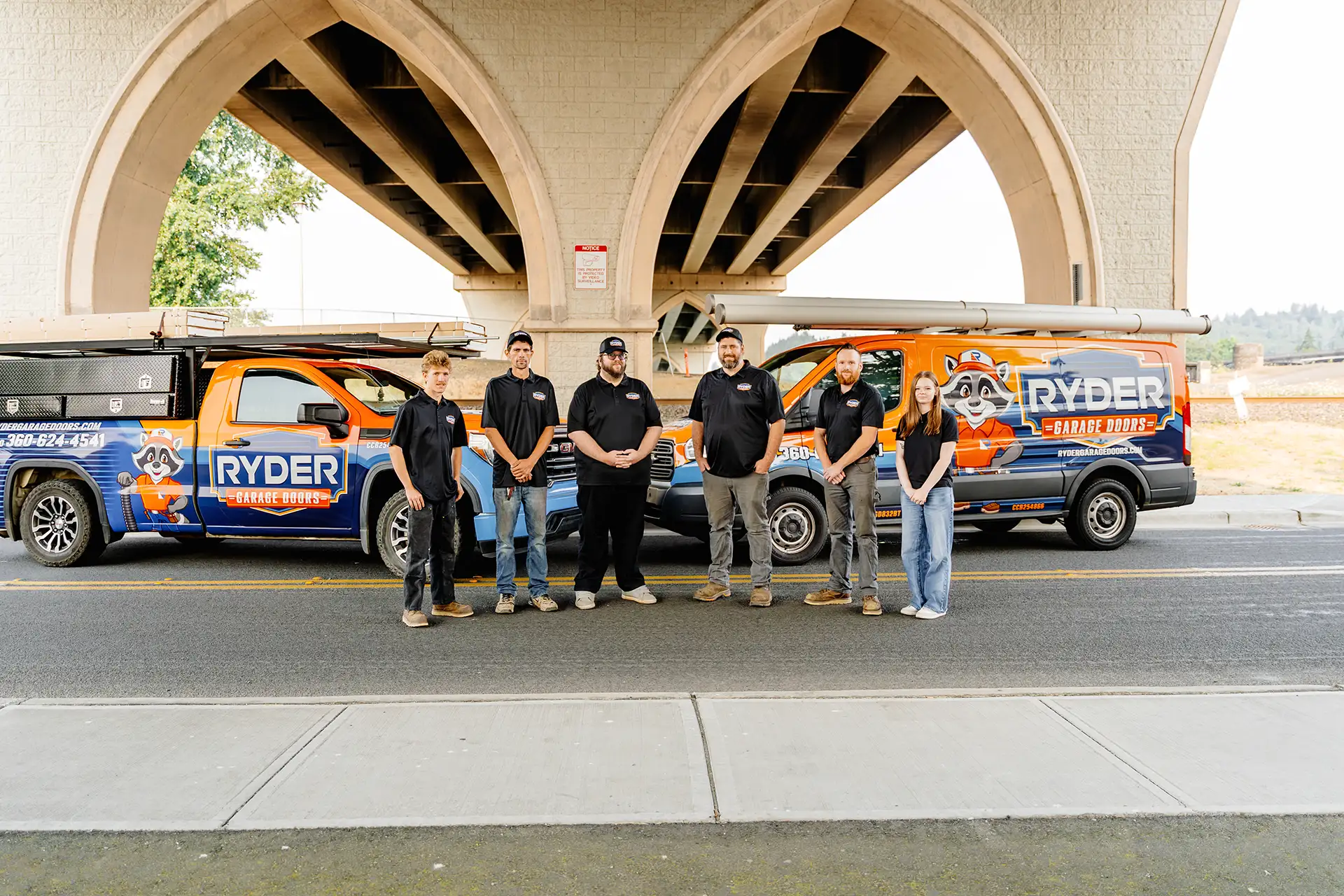
A garage door problem rarely arrives at a convenient time. One Vancouver customer called Ryder Garage Doors after a broken spring trapped the car inside, while an aging, noisy opener had already been making daily use frustrating.
Some symptoms justify a quick homeowner check, but others call for immediate garage door repair. Springs, cables, rollers, hinges, tracks, and the opener must work together.
Ryder Garage Doors is a family-owned company serving Vancouver, Camas, and Washougal. Our experienced technicians diagnose the system, not just the symptom.
Quick Diagnosis: What Your Garage Door Is Telling You
Use this table to decide what to do next. Do not operate the door again when the symptom falls in the stop column.
| What You Notice | Possible Cause | Safe Next Step |
| A visible gap in a spring, a loose cable, a cable off a drum, or a loud bang followed by a door that will not lift | Broken spring or cable-system failure | Stop using the door. Call for repair. |
| The door is crooked, unexpectedly heavy, or will not stay level | Spring, cable, drum, track, or structural problem | Stop using the door. Call for repair. |
| The opener runs, but the door barely moves or does not move | Disconnected trolley, broken spring, stripped drive component, or another mechanical fault | Leave it closed and call for diagnosis, especially if it feels heavy or looks uneven. |
| The door starts down, reverses, and the opening is clear | Blocked or misaligned photo eyes, travel setting, force setting, binding, or opener fault | Clean the lenses and remove obvious obstructions. If the problem remains, schedule service. |
| The door closes with the wall control but not the remote | Remote battery, programming, antenna, or radio-interference issue | Try a fresh remote battery and check the opener manual. Do not open the motor housing. |
| Grinding, popping, squealing, or scraping grows louder | Worn rollers or hinges, loose hardware, poor alignment, opener wear, or spring-system trouble | Stop if the door shakes, binds, or hangs unevenly. Otherwise, schedule an inspection before wear spreads. |
| The door moves slowly or pauses | Binding, balance trouble, worn hardware, opener setting, or motor wear | Watch one cycle from a safe distance. If movement is uneven or the door seems heavy, stop use and call. |
| The opener has no lights or response | Power loss, tripped breaker, GFCI, wall-control issue, wiring fault, or failed opener electronics | Check household power only. Electrical wiring and logic-board work are not DIY repairs. |
Call Immediately for Spring, Cable, Drum, or Balance Problems
The clearest repair call is a door that no longer supports its own weight correctly. A broken torsion spring may leave a visible gap above the door, while an extension spring or cable problem may make one side sag.
If you see a broken spring, loose or frayed cable, cable off a drum, crooked door, or a door that feels heavy or unbalanced, do not try it once more.
Do not pull the emergency release, loosen hardware, clamp a cable, wind a spring, or try to lift the door with another person. Stored spring energy and door weight make this work hazardous.
The U.S. Consumer Product Safety Commission says a severely unbalanced garage door can crash to the floor and that a door that binds, sticks, or is not balanced should be serviced by a professional. The agency also recommends checking springs, hardware, and fittings as part of regular inspection.
DASMA’s garage door safety guidance warns users to keep hands and fingers away from springs, hinges, tracks, section joints, and other door parts. It also emphasizes that proper installation, maintenance, operation, and testing are necessary for safe use.
Ryder provides garage door spring repair and can inspect related parts that may have been stressed before or during the failure. That matters because replacing one failed part without checking the rest of the system can leave a second problem waiting.
Call When the Door Will Not Open or Close
A door that will not open may have a control problem, broken spring, or binding hardware. Start by observing without touching moving parts.
If the motor runs while the door stays down, do not assume the opener is the only problem. An opener should not lift a door made extremely heavy by a failed spring.
If the door will not close, look for a trash can, rake, toy, dirt, or spiderweb blocking the photo-eye area near the floor. Wipe the sensor lenses gently and check whether both units appear to be aimed at each other, using the owner’s manual for model-specific indicator lights.
Do not press and hold the wall control to force the door past a photo-eye problem. On some systems, that action can override the normal sensor response, which defeats the purpose of troubleshooting the safety feature.
Persistent reversal can come from binding, damaged rollers, track trouble, travel or force settings, or an opener fault. Ryder’s garage door opener repair service can separate sensor trouble from a mechanical problem.
Call When New Noise Comes With Poor Movement
A garage door does not have to be silent, but a new or worsening sound deserves attention. Grinding may point to roller, bearing, or opener wear, while scraping may occur when a panel or roller is no longer moving cleanly through its path.
Popping, banging, or snapping can be urgent. If a bang is followed by a door that will not lift, looks uneven, or feels heavy, suspect the spring or cable system.
A squeak during an otherwise smooth cycle may justify maintenance. A harsh sound plus shaking, hesitation, or crooked travel calls for repair.
Do not spray random lubricants on tracks, photo eyes, or opener electronics. Follow the door and opener manuals, or ask a technician to service the system.
During one Vancouver visit, Ryder found that a broken spring was only part of the concern. A noisy older opener and worn components led to a broader discussion involving the motor, rollers, bearings, and cables.
Not every broken spring requires an opener replacement. A diagnosis should show what failed, what is worn, and which items are optional.
Call When the Door Is Slow, Jerky, or Crooked
A healthy door should move predictably. Hesitation, shuddering, uneven movement, or speed changes can indicate friction, worn rollers or hinges, track interference, balance trouble, or opener strain.
Watch from a safe position without standing or walking beneath the moving door. DASMA advises keeping the door in sight until it stops and never trying to “beat the door.”
A crooked door is not a wait-and-see problem.
Do not try to straighten the door, push a roller into the track, or tighten a cable. The visible symptom may be the result of uneven spring tension, a cable that has jumped a drum, damaged track, or multiple faults.
For a door that remains level but is becoming rough or noisy, timely garage door maintenance may help identify worn rollers, hinges, bearings, or fasteners before the system stops working. Maintenance is not a substitute for repair when the door is already heavy, crooked, or unstable.
Call When the Opener Behaves Inconsistently
Intermittent problems include an unresponsive remote, flashing lights, repeat stopping points, or lost travel position. Diagnosis must consider both the opener and door.
You can replace a remote battery, confirm household power, and check for vacation or lock mode. Consult the exact owner’s manual for indicator lights and programming.
Stop before removing the opener cover or working on wiring, capacitors, circuit boards, or internal drive parts. Electrical diagnosis and logic-board repair are not DIY tasks.
Repeatedly raising force or changing travel settings can hide a binding door instead of fixing it. If an opener suddenly needs more force to move the door, a technician should check the door’s mechanical condition before treating the setting as the solution.
After opener work, Ryder tests the photo eyes and force-reversal response. CPSC guidance calls for a 2-by-4 placed flat in the door’s path and discontinuing opener use if the door does not reverse.
Only test after confirming there is no broken spring, damaged cable, crooked or heavy door, or unstable hardware. If it fails, stop automatic operation rather than increasing force.
Safe Checks Before You Schedule Repair
A short, no-tools check can give a technician useful information. It should never involve dismantling hardware or placing yourself under the door.
- Look before operating. From a distance, check for a spring gap, hanging cable, crooked section, roller out of track, damaged panel, or object in the opening.
- Confirm household power. If the opener is completely unresponsive, check whether its plug is secure and whether the relevant breaker or GFCI has tripped. Do not repeatedly reset a circuit that trips again.
- Check controls. Try the wall control and a remote with a fresh battery. Note whether one works and the other does not.
- Inspect the photo-eye area. Remove objects from the opening and gently clean the lenses. Do not bypass, relocate, or hold the wall button to defeat the sensors.
- Listen and observe once. If no hard-stop sign is present, watch one complete cycle from a safe position and record where the sound or hesitation occurs.
- Stop when the evidence changes. If the door becomes crooked, heavy, unstable, or louder, discontinue use and call.
Photos from a safe position can help explain the symptom. Never approach an unstable door for a better image.
What a Garage Door Repair Visit Should Cover
Good troubleshooting begins with the complaint and expands to the system. A technician may inspect springs, cables, drums, rollers, hinges, bearings, track, panels, opener controls, sensors, and safety reversal.
The sequence matters. Mechanical binding or poor balance should be identified before an opener is adjusted, because the opener may be reacting to resistance rather than causing it.
A recommendation should distinguish the failure, related wear, safety concerns, and optional upgrades. You should understand why each part needs attention.
Ryder’s experienced technicians handle garage door repair services for problems involving openers, springs, panels, rollers, hinges, and related components. Same-day and emergency help may be available, but scheduling depends on call volume, location, parts, and the repair required.
Repair or Replace: How to Decide
Many isolated problems are repairable when the door sections and the rest of the system remain suitable.
Consider replacement when several sections are damaged, safety performance is inadequate, failures repeat, or multiple major components are worn. Appearance, insulation, security, and convenience are separate from an urgent safety repair.
There is no responsible flat price for every problem. Door size, spring design, parts, damage, opener model, labor, and related wear affect the scope, so this article does not publish an unverified national range.
Ask for an inspection-based explanation of the options. A sound recommendation should clarify what restores operation now and what, if anything, is an optional upgrade.
When to Call Ryder Garage Doors
Call when the door is unsafe, unusable, worsening, or no longer moving consistently. Call sooner when a vehicle is trapped, the home cannot be secured, or the failure affects your only practical entrance.
Ryder serves Vancouver and nearby Southwest Washington communities, including Camas and Washougal. Learn about service in Camas or contact Ryder Garage Doors to describe the symptoms.
The office is at 1417 NE 76th Street, Suite G17, Vancouver, WA 98665. Hours are Monday through Friday, 7:00 AM to 6:00 PM; Saturday, 7:00 AM to 2:00 PM; and Sunday closed.
Call (360) 843-7981. If the door has a broken spring, cable or drum problem, or is crooked, heavy, or unbalanced, leave it alone while you wait for guidance.
Frequently Asked Questions
Can I Open a Garage Door With a Broken Spring?
A broken spring can make the door extremely heavy and stress other hardware. Do not pull the emergency release or try to lift the door; arrange repair.
Why Does My Garage Door Close and Then Reopen?
An obstruction, dirty or misaligned photo eye, binding door, travel setting, force setting, or opener fault may be responsible. Remove obvious obstructions and gently clean the lenses, but do not hold the wall control to override the sensors.
If the problem continues, schedule diagnosis. Stop sooner if the door is crooked, shaking, or making harsh mechanical sounds.
Is a Noisy Garage Door an Emergency?
Not every squeak is an emergency, but a bang, pop, grinding sound, or scraping paired with uneven or failed movement can signal a serious problem. If the door becomes crooked, heavy, or unbalanced, stop immediately.
For a level door that still moves normally, schedule an inspection before the sound and wear worsen.
Can I Repair Garage Door Cables or Drums Myself?
Cables and drums work with the spring system and can be under significant tension. Do not loosen, clamp, rewind, or reposition them.
What Can I Check Before Calling for Garage Door Repair?
Look for obvious damage from a safe distance, clear objects from the opening, clean photo-eye lenses, check household power, and try a fresh remote battery. Do not remove covers, touch wiring, adjust springs or cables, or stand beneath a moving door.
Note what the door does and where it stops. That information can speed up diagnosis.
How Much Does Garage Door Repair Cost?
The cost depends on the failed component, door size and weight, opener model, parts, labor, and whether related damage is present. An on-site diagnosis is more honest than a broad estimate that may not fit your door.
Ask the technician to separate necessary repairs from optional upgrades. Ryder can explain the scope after inspecting the system.
Does Ryder Garage Doors Offer Same-Day or Emergency Repair?
Yes, Ryder offers same-day and emergency service, subject to technician availability, location, parts, and the repair required. Call (360) 843-7981 to explain whether the door is unsafe, a vehicle is trapped, or the home cannot be secured.